The Importance of Exercise Basics
Understanding the basics of exercise is essential if you aim to achieve results at the gym, lose weight, and build muscle. Mastering these fundamentals not only helps you reach your fitness goals more efficiently but also ensures that you do so safely. However, many people often perform basic exercises incorrectly, which can jeopardize their health and negate their hard work. In this section, we will delve into the importance of exercise basics and provide insights into how to perform them correctly.
Why Exercise Basics Matter
Foundation for Progress: The basics of exercise serve as the foundation upon which more advanced workouts are built. Proper form and technique in basic exercises such as squats, push-ups, and deadlifts are crucial for progressing to more complex movements. Without a solid foundation, you risk injury and may find it challenging to advance in your fitness journey.
Injury Prevention: Performing exercises with incorrect form can lead to various injuries, including strains, sprains, and even more severe conditions such as herniated discs or torn ligaments. By mastering the basics and ensuring proper form, you significantly reduce the risk of injury, allowing you to maintain a consistent workout routine.
Maximizing Efficiency: Correctly performing basic exercises ensures that you are targeting the intended muscle groups effectively. This maximizes the efficiency of your workouts, helping you to see results more quickly. Poor form can lead to compensatory movements, where other muscles take over the work, reducing the effectiveness of the exercise.
Building Muscle and Strength: Proper execution of basic exercises is key to building muscle and strength. When you perform exercises correctly, you engage the muscles fully, leading to better muscle activation and growth. This is particularly important for compound movements that work multiple muscle groups simultaneously.
Common Mistakes and How to Avoid Them
Squats: A common mistake in squats is allowing the knees to cave inward. To avoid this, focus on keeping your knees aligned with your toes and engage your glutes and core throughout the movement.
Push-Ups: Many people perform push-ups with their hips sagging or elevated. Maintain a straight line from your head to your heels, engaging your core to keep your body stable.
Deadlifts: Rounding the back during deadlifts is a frequent error that can lead to serious injury. Keep your back straight, shoulders back, and lift with your legs, not your back.
Planks: Improper plank form often involves letting the hips drop or rise too high. Keep your body in a straight line, engage your core, and hold the position without compromising form.
Conclusion
Mastering the basics of exercise is crucial for achieving your fitness goals, whether it's losing weight, building muscle, or improving overall health. Proper form and technique lay the foundation for progress, prevent injuries, and maximize workout efficiency. By focusing on these fundamentals and avoiding common mistakes, you can ensure a safer and more effective fitness journey. Remember, the time and effort you invest in learning and practicing the basics will pay off in the long run, leading to better results and a healthier, stronger body.
15.Hip bridge
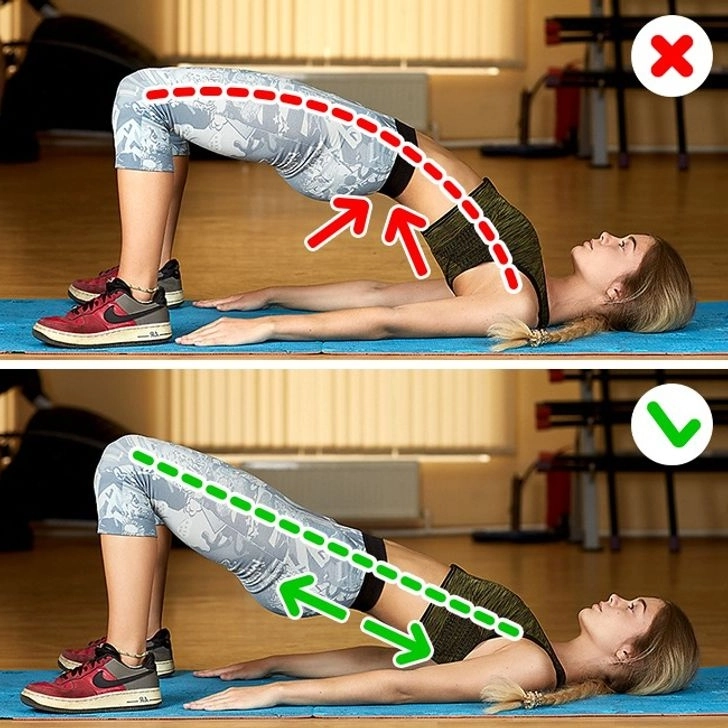
Hip Bridge Exercise
The hip bridge is a fundamental exercise that targets the glutes, hamstrings, and core. However, performing it incorrectly can lead to unnecessary strain on your lower back rather than effectively working your buttocks. In this section, we will discuss the common mistake people make while performing the hip bridge and provide detailed instructions on how to execute it correctly for maximum benefit.
Common Mistake: Arching the Back
Incorrect Form: One of the most common mistakes during the hip bridge exercise is arching the back. When you arch your back, the load shifts from your glutes to your lower back, which can cause discomfort and potential injury. This improper form undermines the effectiveness of the exercise and prevents you from fully engaging the target muscles.
Correct Form: Proper Alignment and Engagement
Step-by-Step Instructions:
Starting Position: Lie on your back with your knees bent and feet flat on the ground, hip-width apart. Your arms should be at your sides with palms facing down.
Knee Alignment: Ensure that your knees are bent at a 90-degree angle, forming a straight line from your knees to your ankles. This alignment is crucial for maintaining proper form and maximizing muscle engagement.
Pelvic Lift: Slowly raise your pelvis towards the ceiling, lifting your hips off the ground. As you lift, focus on keeping your body in a straight line from your shoulders to your knees. Avoid arching your back by engaging your core muscles.
Peak Contraction: At the top of the movement, squeeze your glutes as hard as you can. This peak contraction is essential for activating the glute muscles effectively. Simultaneously, tighten your abs to support your lower back and maintain stability.
Hold and Lower: Hold the top position for a few seconds while maintaining the squeeze in your glutes and the tension in your abs. Then, slowly lower your hips back to the starting position, ensuring that you do not arch your back during the descent.
Breathing: Inhale as you prepare to lift your hips and exhale as you raise them. Maintain steady breathing throughout the exercise to ensure proper oxygen flow and muscle function.
Tips for Success
Focus on Form: Always prioritize proper form over the number of repetitions. Quality is more important than quantity when it comes to effective exercise.
Use a Mirror: If possible, perform the hip bridge in front of a mirror to monitor your form and ensure that your body remains in a straight line.
Progress Gradually: Start with a few repetitions and gradually increase the number as you become more comfortable with the exercise. You can also add resistance by placing a weight on your hips for an added challenge.
Conclusion
The hip bridge is an excellent exercise for strengthening the glutes, hamstrings, and core, but it must be performed with proper form to avoid unnecessary strain on the lower back. By ensuring your knees are bent at a 90-degree angle, raising your pelvis to create a straight line from your shoulders to your knees, and squeezing your glutes and tightening your abs at the peak, you can maximize the effectiveness of this exercise. Remember, focusing on form and engaging the correct muscles will lead to better results and a safer workout experience. Incorporate these tips into your routine to enhance your hip bridge performance and achieve your fitness goals.
Leave a Reply